Showing posts with label waves. Show all posts

Monday, May 11, 2015

8th Grade Final Exam

It's been a while.  But I feel the end of the year is like that.  I'm not really going over anything new, we're just reviewing everything we've already done.  And then there are a lot of activities and meetings towards the end of the year.

Does anyone else feel like the end of the year is both a drag (still 3 more weeks left??) and a sprint to the finish (only 3 more weeks left??)?

Today my eighth graders took their final exam.  My first class left me very pleased with the results.  More than half the class received A's and B's.  That's awesome.  I don't give easy tests and I expect a lot.  So I was very pleased.

My second class was not as good. Only one kid passed, and he passed with a 95%.  How can there be that much difference?  This class is hard to control, they're often yelling at each other, and don't always try their best.  Even during the exam they were asking why they couldn't take notes (um, you don't even have any??) because "all" of the other classes let them use notes.  Well, looking from experience, I've never let you use notes on a test, so why would I let you use notes now?  I want to see how much you have learned, not how well you can take and read your notes.  Needless to say this second period was difficult and hard.  I don't think I'm entirely to blame, but I do have a lot of notes on how I'm going to improve next year.

After all, I'm a brand new teacher.  There is much room for improvement.

Here's my copy of the eighth grade exam.  I was quite pleased with it.  :)


How well would you do on an eighth grade science test?


Wednesday, February 25, 2015

Waves Test

This is it.  We're done with waves––both sound and light.  YAY!

Here's my test below.
Here's the review.


Now, on to electricity!

Monday, February 23, 2015

Final Wave Review

We are officially done with waves––both sound and light.

Today we finished off our last class of it by having a mini-lesson on what a lightyear is and why it's important, and then we did a final review for powerpoint.


These questions on the review are pretty close (if not word for word) to the questions on their test next class.  I had them get out a piece of paper, copy down the question, then we'd talk about what they thought the answer was, I would show the answer, and they would copy it down.

Most of the kids were doing really well on the review.  I had two boys in front for one of my classes that would celebrate with multiple, loud high-fives with big smiles every time one of them answered a question correctly.  The girls in that class just rolled their eyes at them. hahaha.  Middle school.

To download my powerpoint, click here.

Wednesday, February 11, 2015

Introducing: Light!

So we've already sorta started light with my eighth graders.  We had done the experiment on lightning/thunder to solidify their knowledge that light is faster than sound.  But I kind of back-tracked and finished sound with more gusto than I thought I would.  So now we're officially starting light.

Yesterday's class was a lot of lecture and note taking.  We watched little videos throughout (that I found on unitedstreaming.com) to help demonstrate the different principles we were talking about.  I tried to do little demonstrations throughout as well, to make sure they understood what they were writing down.

I made guided notes.  They can use these throughout the unit to help them on their worksheets, but they can't use them on quizzes/tests.

To get the guided notes, click below.

Light Notes: Page 1

Light Notes: Page 2

There was then a follow-up worksheet for them to do.  I didn't anticipate how long it would take to do the notes (it took almost the entire 1.5 hour block!).  Instead of doing the worksheet, I had them take out an extra sheet of paper and draw 2-3 examples of light reflecting off an object and into our eye.  They had to name the colors reflected and the colors absorbed by the object.

Here's the worksheet we would have done, and which we'll probably do next week (or sometime later in the unit as a review).

To get this worksheet, click below.

Light Reflection and Absorption Worksheet

Thursday, February 5, 2015

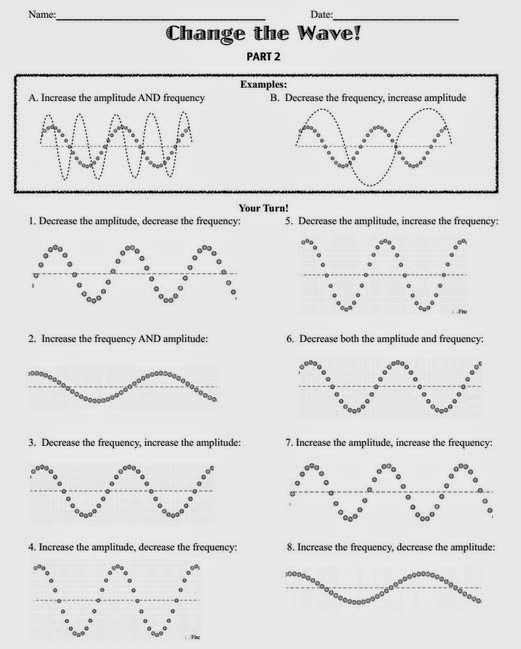
Revisiting Amplitude and Frequency

Remember when I said my kids need lots of review?  (If you need a review, check out this post.)

I really want my kids to be good at amplitude and frequency.  This lesson was tricky for them.  It really made them think.  But I think that's why I really liked this lesson.  It was hard!  It was tricky!  They actually had to use their brains!  THAT'S AWESOME.

We did lots of examples as a class first.  I modeled it a few times, and then I had them come up to the smart-board to give it a go.

––––––––––––––––––––––––––––––––––––––––––––––
Teaching Secret for Success:
It's really important to get the kids to practice the skill as a group (guided practice!!) before you give them the worksheet.  This way you can immediately identify and address any severe misconceptions they all have and how to fix it.  


––––––––––––––––––––––––––––––––––––––––––––––

I guess my professors in college really knew their stuff when they drilled into our brains the following lesson outline:

I do -- We do -- You do. 
i.e.
Model - Lead - Test.
i.e.
The kids watch me do it, the kids do it with me, then the kids show their stuff and do it on their own.


––––––––––––––––––––––––––––––––––––––––––––––


When kids come up and do it with me, you can see that when I say "increase the amplitude," they're only increasing the crest and not deepening the trough.  Or other problems.  Then the kids like to come up when someone doesn't get it right and try to fix it.  It actually worked out well that no one's feelings got hurt, because even if they got it wrong one time, the next time they were the one wanting to fix someone else's mistake.  This wouldn't work in ever class.  The dynamics between your students is everything. 

Here's the worksheet we did today.  Again, it caused them to really think about what amplitude and frequency really meant, and how to increase or decrease both. 

Click below to get the worksheet. 


Monday, February 2, 2015

Review Games


The Truth About These Origami Owl Reviews

My kids often need a lot of review.

No, that's an understatement.

My kids always need A LOT of review.  A LOT of it.

If they don't review something over and over and over again, then they're not going to learn it. I don't know if that's because they're sped, or because the material is new (and let's face it, they don't have much science instruction in elementary school, so it's almost brand new when they start in middle school), or because of both factors.  Probably both.

So I'm always strangling myself trying to think of brand new ways to present the exact same material so they don't get bored of it.
_________________________________________________

Management Skills:
If kids are bored, they start engaging in all sorts of inappropriate behavior that leads to a non-functioning class. 
It's a sad, hard truth. 
_________________________________________________

Oh, wait!  You thought you'd actually be teaching when you signed up for this? 
Oh, no, no, no.  
You're there to entertain. 
_____________________________________________________________

At the beginning of the year when my seventh graders were learning the parts of the cell, I created a large concentration game that we played all together one day, and then I used as a fast finisher later on during that unit.  It worked great. (I'll post those cards up another day).

My eight graders are learning about waves right now.  They appeared to know the information pretty well, so I gave them a quiz on it. 

Find quiz here

 
You'll notice that on the actual document I have 4 versions of the same thing.  It helps to eliminate cheating.

Yeah . . . they didn't know it as well as I thought. So I'm now looking for ways to reteach them these things: crest, trough, amplitude, frequency, wavelength, amplitude = volume, frequency = pitch.  

I found this great website that listed a bunch of new review games that I hadn't heard of before.  You check out that website here.  I'm using their Trash Ball game on Monday, because my kids already love throwing crumpled paper across the room (unfortunately).  

Since there aren't very many terms and concepts that we're reviewing, I have multiple presentations of the same idea.  The items have points assigned to them, with recall being 1 point.  Highest points are 5 points.  Is it perfect?  No, but I doubt the kids will care.  They'll just like being able to earn points.  I'm going to have them all cut up and folded so the questions are chosen at random. 

To see my review questions, download here:


All of the questions cut up and ready to choose from. 

I was really proud of my students.  This class did an excellent job of giving honest attempts when answering the questions, and they were all involved.  I really feel like this did the job at reviewing concepts again in a fun way.

The final result. 
My second class that came in and I did this with didn't do as well, but that class has too much middle school drama in it.  Too bad.  They enjoyed it, but it didn't go as well as the first.  It really depends on your students and if they can handle the excitement of throwing a piece of paper into the trash (they act like it's the best thing they've ever been allowed to do!).

All in all, I'd do this game again.  It was easy to make and fun to do. 

Friday, January 30, 2015

The Speed of Light and Sound Experiment

When I was in school my physics teacher did an awesome experiment that I've always remembered.  We went outside to the fields.  He stood at one end of the field, and we were all the way down at the other end.  At the same time, he waved a flag down and shot a starting pistol, and we timed the difference between us watching the flag fall and us finally hearing the sound of the pistol.  The purpose of that experiment was to measure the speed of sound.

However, that was high school.  This is middle school.  And this is a middle school that doesn't happen to have starting pistols in our supply closet.

But I still wanted to do a cool experiment that would help my kids better remember that light is much, much, faster than sound.  Sure, I could tell them and show them the numbers, but that's not going to be as memorable.

Today's Mini-Experiment:

Question: Do light waves or sound waves travel faster?
Hypothesis: I hypothesize that _________ travel faster than _________. (modified hypothesis outline)
Experiment: I watched a video about lightning and thunder. (they loved watching all of these lightning strikes.  I enjoyed it, too.)

Movie is 1:49 minutes long.

Conclusion: My hypothesis stated that _____________.  My results do/do not support my hypothesis.  The results show ___(that light travels faster than sound)___ because, ___(light does not require a medium).  


I had to give them the "because" statement, but we had a discussion on what it meant.  I realized that although we had talked about the word "medium" before, and that sound needs solid/liquid/gas to travel through, they still were unsure on the vocab word.  So I write down "Math Medium" and "Science Medium" on the board.  The math medium means in the middle.  The science medium means matter that something is traveling through.  

I think they understood what I was trying to say.  They were at least able to regurgitate some sort of explanation to their partners during "Partner Teach."


This only took 20-30 minutes depending on questions and initial level of understanding.  The kids did their entire write-ups.  I haven't graded them yet, but they looked pretty good from what I saw. 

Thursday, January 29, 2015

Wave Frequency Experiment

In the Science Storage Room of Magic (SSRM), I found these the other day:

BoomWhakers, pic taken from http://boomwhackers.com/

I pulled them out an hatched a plan.  As a follow-up lesson to our frequency and amplitude lesson, I decided to do a little experiment. This was both to let the kids experience these properties more, and to give them more practice on the hypothesis and conclusion writing (see this post).  I gave them the question.

The Tube Experiment
Question: How does the length of the tube affect the pitch of the sound?
Hypothesis: I hypothesize that an increase/decrease in ______ will increase/decrease the ______.
Experiment: We all took a tube and stood in order of longest to shortest.  We then took turns sounding the tube, starting with the longest tube.  We listened to the sound.
Conclusion: My hypothesis stated that __________. My results do/do not support my hypothesis.  The results show ___________, because ___________.

And that's the basic write up that they did.  Simple and easy.  Remember, I'm in middle school and sped. But we still do it correctly.

After sounding the tubes out, we had a discussion on what the results showed (i.e. an increase in length decreased the pitch, or a decrease in length increased the pitch), and why.  The why was a little confusing for them, but that's more advanced.  All they need to know is that what differs between each tube is the frequency of the wave. 


If you don't have BoomWhackers, then try this experiment.

BE WARNED: 
(1)It's cool, but because it's cool parents and waitresses/waiters everywhere might be forever frustrated.  
(2)It will also create a mess in your classroom. 
(3)Also, this might be good to do at the end of class after all instruction for that day. Otherwise you'll hear annoying noises for the rest of class.


Wednesday, January 28, 2015

Wave Worksheet--Sound and Light

This is another wave worksheet, following up on the worksheet from last time.  This time we are wrapping up on our sound waves and starting to talk about light waves.  The lesson objectives are thus:

(1) review the parts of the wave (crest, trough, wavelength, amplitude, frequency)
(2) explain that light travels faster than sound, and give an example from nature (lightning/thunder)
(3) understand that, unlike sound waves, light can travel through a vacuum because it does not require a medium. 
(4) explain that white light is made up of all of the colors (learn ROY G BIV)
(5) explain simple questions on the reflective property of light. 

That's a lot for one class, but we're not going very much into detail, and I think the kids can handle it.  If not, then we'll pick up where we left off next class.

I have the following video from youtube that I'll be showing in class tomorrow:

Lightning with Thunder Delay

Below are the worksheet and answers:

The following is a visual of the worksheet:


Friday, January 23, 2015

Great simulations!

I used this in class today.  It were awesome and the kids loved watching the wave as we talked about what was happening.  When they finished their worksheet (see previous worksheet on waves) they were allowed to come over to my computer and manipulate it themselves.  I thought I'd share them here.

https://phet.colorado.edu/sims/wave-on-a-string/wave-on-a-string_en.html


This website also has many different simulators, mostly demonstrating properties of physics.  There are a few other simulations for chemistry and biology as well.

https://phet.colorado.edu/en/simulations/category/physics/sound-and-waves

I hope you find it useful!  I used another from this website called "Sound." It allows you to change the frequency and amplitude while you listen to the sound and watch the compression/longitudinal waves coming from the speaker. Pretty cool.