Showing posts with label natural-selection. Show all posts

Wednesday, May 13, 2015

7th Grade Final Exam

This was an awesome day.  Every single one of my seventh graders passed this test (so far, that is;  I had 3 kids absent today and two suspended––yikes!).  I had four kids get 100% and many get A's and B's.  I didn't have too many C's and I think I had 3 D's?

But this wasn't an easy test.  I was proud of my kids for doing so well and remember so much material over the past year.  These kids are awesome.

I loved walking around as my kids were taking the test.  I would occasionally read the question for them if they asked (this is sped and I am testing them on their science knowledge and not their reading abilities.  I let them read by themselves if they choose to, but I always read test questions when they ask).  During some instances when I read the question, the student would think about it, then have a happy gasp as they said, "oh, I know this one!"  One kid turned to the third page and a big smile came on his face as he quickly started filling in the answers.

I loved it.  Again, this was not an easy test.  These kids worked really hard this year.  They paid attention and completed their assignments.  I'm really proud of them.

Throughout the year my tests have been challenging.  Some of my students have complained that my tests are long.  And I agree with them.  I'm still learning how to ensure I get both breadth and depth in my exams (especially when covering the entire year) and keep it to one page.  Because I have yet to learn this, I brought in little cookies, and I told the kids that when they were done with half of it, I would put a cookie on their desk for "brain energy."  They seemed to enjoy that.

I had a few polite "Thank You"'s when they received their cook, which I quite appreciated, too.  You don't always get that here.

It was so funny to see the worry on their faces when they turned in the exam.  One girl kept exclaiming to herself, "I think I got a bad grade . . . ?"  I graded the tests during the same class period (again, this is sped––I don't have that many kids in there so I can grade these really fast).  When I returned it to her she saw she had received a 100%. She quietly scanned the page reading the little note I had written her, then raised her hands up with a big celebratory shout.  It was adorable.  She kept look through her test over and over again like she couldn't believe it.

If this was an easy test their victory wouldn't have been as sweet.  I don't give easy tests.  They can do much more than that.


Anyway, this is our seventh grade science final exam.


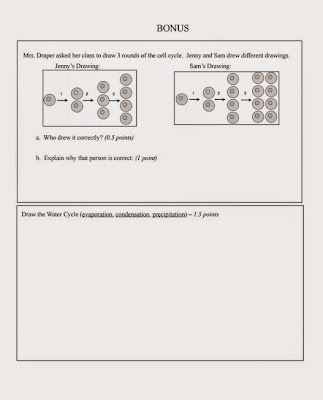
They all seemed to enjoy the bonus questions.  I had 100% participation on the bonus during this test, which isn't always the case.  I find the bonus questions are motivating because it's a non-threatening way for them to take a chance or a positive way to give extra points for what they've learned.

It was through a bonus question on their first quiz that they learned the term "flagellum."  They all struggled with it (I had only mentioned it a couple of times in class).  Afterwards we worked on it together to discover the answer.  I haven't really mentioned "flagellum" since then, but today after the test when I randomly asked "what's the tail-like structure on the animal cells," my students still remembered. 


Wednesday, April 8, 2015

Bones, Bones, Analogous Bones.

I loved this lesson.  I felt like it went really well, was engaging, and the kids loved it.

We just finished our owl pellet dissection.  The bones are all out.  The next step is for the kids to organize the bones into a skeleton.  I felt like they would do much better at that if we first learned what a normal skeleton should look like, and cover a few standards in there at the same time.

I also taught them a few new skeleton terms.

Words most of them already knew:  skull, ribs
Words that were new: vertebrae, humerus, radius/ulna, pelvis.
Generic words I used: fingers, leg bones, toes.

To start with:

The Bell Ringer:

Examples of ways the two species were similar are: two legs, two eyes, no hair (it's hot!), long legs (one to run from predators, the other to reach food)
Examples of ways the two species were different:  Island A may have camouflage. Island B may have long neck.


I kept referring back to this throughout the lesson when kids would give me weird looks.  I'll explain as I go.


Here is a human skeleton.  We started by pointing out different parts of the skeleton and having the kids feel for their own bones––feel your ribs, find your sternum, feel your pelvic bones, etc.

I then had a slide with lots of different animals on it: human, raccoon, mouse, bear, bird, whale, snake, fish.

Which of these have a skeleton like the human?

We had a little vote.  It was unanimous for the land mammals to have similar skeletons.  Maybe whale, maybe bird, definitely not snake or fish.

Then I told them that, except for the fish, every single one of the animals on the board had a pelvic bone.  A reminder that the pelvic bone is your hips and your legs are attached to it.  The kids all agree that the human, mouse, bear, raccoon, and bird have a pelvic bone, because they all have legs.  But they didn't really believe me with the snake or the whale.

Next slide: skeleton images of human, mouse, and snake.  Point out the skull.  Point out the vertebrae, point out the ribs.  All three definitely have this.  Then point out the hips.  (I had to have two separate images of the snake skeleton so they could actually see the small hip bones.)

Why in the world, would the snake have hips??  I had some good hypotheses with this one, actually.  Maybe that's how the snake can lift half of itself up before it strikes?

Actually, dear students, it's because the snake used to have legs.  (Now, okay, okay, it wasn't technically a snake when it had legs––it was an entirely different species back then.  That's farther into the theory of evolution than we need to worry about now.)

WHAAAT??

This is one of those times when you go back to the Bell Ringer, and you explain that once upon a time, there were lizard-like animals.  The population got separated somehow––island, mountain, whatever.  And they needed to adapt to their new environment.  In that new environment, they didn't need legs.  If they didn't need them, would their body put in the energy to make those legs?

One thing you must stress during this lesson is that these changes didn't take place within one animal's lifetime.  The changes occur over millions of years!


Anyway, I did the same thing with a new slide of human skeleton, raccoon skeleton, and whale skeleton.

Introduce the infamous picture of comparative anatomy of the arms. 
I didn't actually use this photo, but I used a similar image in our class textbook.
Can I also say that I have always loved the bat's arm???  How awesome are those fingers?

The visual was really good for the kids and solidified their understanding.  They loved the bat just as much as I did.

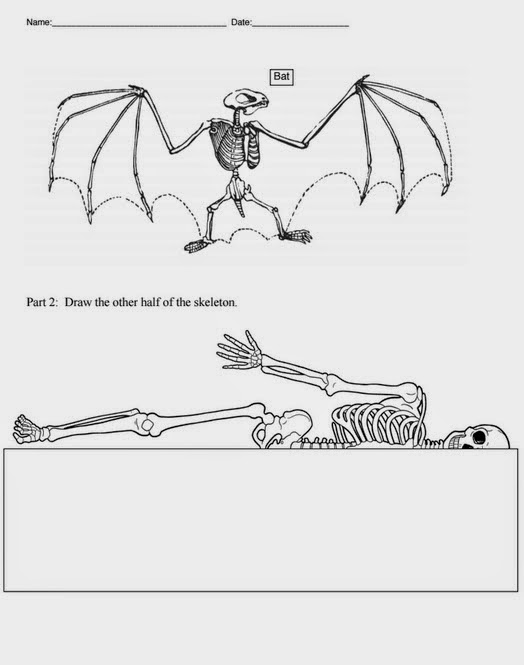
We then went into independent work time. The worksheet was quite simple, but drove home the two objectives I had: (1) learn more about the skeletal anatomy, including new vocabulary words, and (2) understand that comparative anatomy suggests we all descended from a common ancestor.

Oh yeah, and throughout the lesson I talked about how this suggests we all had a common ancestor.  A long, long, long, long time ago, there was the great-great-great-great-great-great-great-great-great-great-great-great- etc. etc. - great grandfather, and from him, we got all of the animals on earth.

Again, tie in the bell ringer.  The skeleton of the two species are going to be the same.  Why would your body put in energy to completely change it when it worked great in the first place?  It might look a little different; for example, a longer neck will mean more vertebrae; but in the end, it's essentially the same skeleton.

Bring in the worksheet: (to download, scroll down to the bottom of the page)


As they did this, I had one group at a time come to our bone cleaning station.  They were to take their bag of bones from the owl pellet lab and clean them all from any left-over dirt and hair.  I'll bleach them   for a little while before our next class, and then we'll start gluing them onto poster paper to make a skeleton image of the diseased pray.

Thus, the worksheet was perfect for our purposes. It solidified our objectives and was simple enough for the kids to complete by themselves with minimal questions asked.  This allowed me to help monitor the bone cleaning station more closely.  Plus, we had music playing in the background, which always makes life more enjoyable.  Successful teaching day.

Friday, April 3, 2015

Reviewing Heredity

Review Day Two: Heredity.

This covered 2 months worth of material.

sexual/asexual reproduction
inherited vs. acquired traits
dominant and recessive traits
karyotypes
a little bit of natural selection mixed in there, too.

The kids did well on this, though not as well as cells. But there was still many good answers and good energy in the classroom.

Click here for the review worksheet.


Thursday, March 12, 2015

Dichotomous Keys

This is a follow-up lesson from our last lesson on natural selection.  I would have liked to have spent more time on understanding it and having the kids explain natural selection in their own terms, but there is just no time.  So today we moved on to dichotomous keys and kind of did a small review on natural selection in our bell ringer.  The concept of natural selection is intuitive, but truly being able to answer a variety of question types on it.  Oh well.

So now we're doing Dichotomous Keys, and that finishes the week (I only got to see my seventh graders twice this week).  So next week is complete review, and the week after that is the state test!

After first explaining what a dichotomous key is and how it works, I handed out the following worksheet and did the first three with them, and then let them do the rest with a partner.  Dichotomous keys aren't hard to use, so kids get the gist of it really quick.  I felt that it was an important part of the evolution unit and might be on the state test. I might also be completely wrong.  We'll see!


Here's a preview of the worksheet.  To download, scroll to the bottom of the page.


I then found this wonderful worksheet on the web.  I did not make this!  Someone else who was talented (and probably beautiful!) made this worksheet and gracefully had it up for free on the internet.  I thought it was so good, however, that I wanted to post it here, too.  I love it because it has a very well done dichotomous key, and then it has the little opportunity for the kids to do one, too.

 Now, you can choose to do this some other way.  In fact, we had extra time, so I had everyone put one of their shoes in the middle, and we made another dichotomous key together for our shoes.  Some kids gladly took their shoes off and others took a lot more convincing–– lots  of funny comments:

"Miss, my shoes are really hot and smelly."

"Eww, Miss!  His feet stink!!!"

"They're going to laugh at my socks!"

"I'm not wearing any socks!"  What?  Where are your socks??

After pulling teeth with one girl to take one of her shoes off, she said, "Oh. . . I feel like I'm in my house."

Scroll to the bottom to download the worksheet I found that someone else had made.  Preview:


Tuesday, March 10, 2015

Natural Selection Project

We don't have very much time for our evolution unit.  In fact, I'm only budgeting two classes for this (which stinks--one of my classes didn't even get to me today. The testing schedule was so crazy that our last class never happened and our third block just lasted twice the time.).  We have this week for evolution, then next week is REVIEW THE ENTIRE YEAR, and then the week after that is the big science tests.

Yay. Right?  Yay???

Anyway.  Because I didn't have much time, I had to make these two days good and worth it.  Today the lesson was focused on Natural Selection.  Thursday's lesson will be on classification, with a focus on reading and making dichotomous keys. 

I was SO excited about this lesson.  There were a lot of good interactive parts.

We started out with this Power Point activity:


Then we went to this website to play the actual game.  The online game allows you to make mutations to see if that can prolong your time on earth.  The kids loved it.  It's a fast game, so I had 3-4 students come up and try their hand at it.  Click here to go to the game.


Afterwards, we learned about Charles Darwin in this Power Point.  Who he was, what he did.  We talked about what evolution is and what natural selection is.


Then the kids had to create a project, which was indicated on the last slide of the second Power Point.  My example is below.  This is what I drew at home the night before.  In class I colored it up a bit to make it nicer. 


Example Student's project (kind of hard to see--the only camera I had available was my computer camera, and it's not very good. Apologies!)


The kids did really well with this assignment. I was pleased with the outcome. There was one last step, and that was to take their data from the chart at the beginning and make a graph from that.  This graph was attached to their project to show whether or not their species actually survived.  The graphing was hard for my kids.  We all figured it out eventually.