Showing posts with label ecology. Show all posts

Wednesday, May 13, 2015

7th Grade Final Exam

This was an awesome day.  Every single one of my seventh graders passed this test (so far, that is;  I had 3 kids absent today and two suspended––yikes!).  I had four kids get 100% and many get A's and B's.  I didn't have too many C's and I think I had 3 D's?

But this wasn't an easy test.  I was proud of my kids for doing so well and remember so much material over the past year.  These kids are awesome.

I loved walking around as my kids were taking the test.  I would occasionally read the question for them if they asked (this is sped and I am testing them on their science knowledge and not their reading abilities.  I let them read by themselves if they choose to, but I always read test questions when they ask).  During some instances when I read the question, the student would think about it, then have a happy gasp as they said, "oh, I know this one!"  One kid turned to the third page and a big smile came on his face as he quickly started filling in the answers.

I loved it.  Again, this was not an easy test.  These kids worked really hard this year.  They paid attention and completed their assignments.  I'm really proud of them.

Throughout the year my tests have been challenging.  Some of my students have complained that my tests are long.  And I agree with them.  I'm still learning how to ensure I get both breadth and depth in my exams (especially when covering the entire year) and keep it to one page.  Because I have yet to learn this, I brought in little cookies, and I told the kids that when they were done with half of it, I would put a cookie on their desk for "brain energy."  They seemed to enjoy that.

I had a few polite "Thank You"'s when they received their cook, which I quite appreciated, too.  You don't always get that here.

It was so funny to see the worry on their faces when they turned in the exam.  One girl kept exclaiming to herself, "I think I got a bad grade . . . ?"  I graded the tests during the same class period (again, this is sped––I don't have that many kids in there so I can grade these really fast).  When I returned it to her she saw she had received a 100%. She quietly scanned the page reading the little note I had written her, then raised her hands up with a big celebratory shout.  It was adorable.  She kept look through her test over and over again like she couldn't believe it.

If this was an easy test their victory wouldn't have been as sweet.  I don't give easy tests.  They can do much more than that.


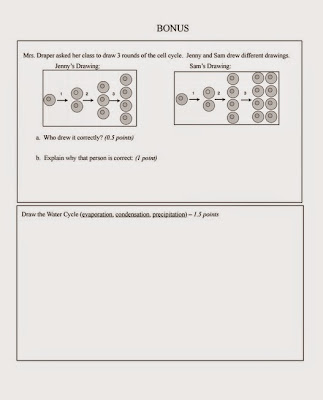
Anyway, this is our seventh grade science final exam.


They all seemed to enjoy the bonus questions.  I had 100% participation on the bonus during this test, which isn't always the case.  I find the bonus questions are motivating because it's a non-threatening way for them to take a chance or a positive way to give extra points for what they've learned.

It was through a bonus question on their first quiz that they learned the term "flagellum."  They all struggled with it (I had only mentioned it a couple of times in class).  Afterwards we worked on it together to discover the answer.  I haven't really mentioned "flagellum" since then, but today after the test when I randomly asked "what's the tail-like structure on the animal cells," my students still remembered. 


Monday, April 13, 2015

Owl Pellet Skeleton Reconstruction

The last step of our owl pellet lab is here!  (See part 1 and part 2.)

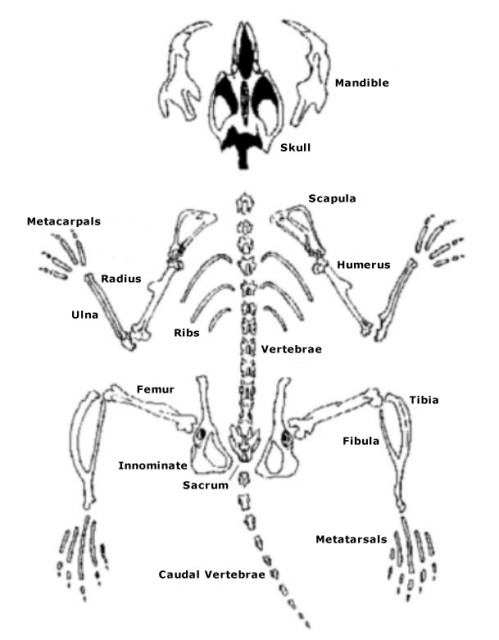
The kids are taking their washed bones and gluing them into a complete skeleton.  For their reference, I'll have the following image on the smart-board for them all to reference throughout the lesson.

Click here for image.

The rubric requires the following things: bones placed correctly, missing bones drawn in, bones labeled correctly, neatly done.  The kids and I will work together beforehand to determine what exceeds expectation, meets expectation, and doesn't meet expectation for each criteria.  

In the end, it will look something like this.  This is my example I did for the kids to look at.  


You can already see there are a few scientific terms I'm not worrying about for my sped kids: mandible (jaw), metacarpals (fingers), metatarsals (toes), innominate (I'm using pelvis instead), and I'm not doing sacrum at all.

This should be lots of fun tomorrow. I'm excited about it. :D

Monday, April 6, 2015

Owl Pellet Dissection

This was an awesome class.

Have you ever dissected an owl pellet before??

Do you even know what an owl pellet is?  Well, let me inform you.  An owl will swallow it's meal whole, usually.  However, it does not digest everything it eats and the only way for it to get out safely is for the owl to regurgitate it.  Thus, a ball of hair, bones, and saliva are excreted from the owl's mouth.  The pellet.
Owl Pellets for use.  They seem small, but you'd be surprised how many bones you find inside one pellet.

Sounds disgusting, right? Yeah, well, it is if you think to much about it.  I had one of my students put on a permanently disgusted face the whole time I was explaining our task for the day.  But once you get into it you kind of forget what you're working with and just focus on discovering all of the bones in your pellet.

Can I just say that I have never had an entire group of middle schoolers so quiet and captivated for an entire 40-minute period?  They loved it.

Our beginning Bell Ringer.  The writing on the poster was small, so I allowed the kids to come up to the board to get their answers.  The red answers are what they told me after everyone was done.  
One of the posters in our board.  This was a great visual to use.
This dissection was optimally placed in our curriculum.  The kids had just taken a 3-day test and were exhausted.  No one wanted to do any work (teachers included).  So I scheduled our dissection for Thursday––after the test and right before spring break (another reason no one wanted to do any work). In and of itself it is engaging, and there is so much you can learn in a single session.  Plus, the kids are basically discovering and teaching themselves, so all the teacher has to do is facilitate that flow of knowledge.
This was the poster-sized bone chart.  Each partnership also had their own bone chart to use.
All of the posters in the class that day.  Available for students to use and compare their own bones to.  

What you learn in an owl pellet dissection:

  • Lab safety
  • Food Webs––what is the owl eating?
  • Physiology––digestion of owls and bone structure of small rodents.  Also, how many animals can an owl eat at one time?
  • Scientific Inquiry––what animal does this skull belong to and why do I think that?
  • Environmental Factors
  • Ecosystems
  • Evolution –– common descent with bone structures
  • Anything you want 
This can be done in one class period, or you can extend it into an entire interactive project.  I'm going to try and extend this project out. Not only are we done with testing (thus, relaxing the schedule a bit), but this is an engaging project and many students have already asked the next steps, i.e. what are we doing with the bones we've found?

So I'm excited.  The kids are excited.  This is an excellent project for any age.  The pellets are a bit expensive, but believe me when I say they are totally worth it.  TOTALLY.  So worth it that every year our principal buys enough for the entire 7th-grade to do this dissection. 
This video came with the materials, I think.
It was a great 15-minute introduction to Barn Owl life and the Owl Pellet Lab.
Starting the dissection

They split their pellet in two so they could each work on a section.


Very cool discovery––a skull!  A hairy skull, but a skull nonetheless.


One group's pile of bones. 

Wednesday, March 4, 2015

Ecology Unit Test

My seventh graders are finished with their ecology unit.

OH MY GOODNESS TESTING IS IN THREE WEEKS!!

Excuse that little outburst right there.

But really, March just started!  How can you expect the students to have learned one year's worth of science when it's only March?!  And this is sped, too.  We need to review.   We seriously need to review.  What's worse is that they're taking their language arts and math tests this week, so I see only some of them some of the time while they're testing.  So this is basically a wasted week.  I could really be screaming:

OH MY GOODNESS TESTING IS IN TWO WEEKS (ADJUSTED)!!

Okay so we're finishing off ecology.  There's a test.  We have one week on the important parts of evolution, one week of INTENSE REVIEW, then it's testing time.  After that we'll go back and teach everything about evolution that we didn't get to teach, plus the other two units that are scheduled for April and May (Oh, and there will probably be a couple of questions on the test pertaining to the material you were never able to get to).  Sigh.

And now, getting back on track:

HERE'S THE TEST!

To download it, scroll to the bottom of the page.  

(Since they're already taking PARCC testing for LA and math, I thought I would be nice and give them multiple easy bonus questions, just to make them feel better about tests and their life in general. That was exceedingly thoughtful of me, I know.)


Tuesday, February 24, 2015

Habitats & Niches

I was excited about this lesson.  On the smart-board I had this picture enlarged, which I got from google somewhere:


I then had a bunch of different pictures of rainforest animals printed out and laminated.  I handed them out to the kids so each kid had one.  We talked about the different parts of the rainforest (canopy, understory, forest floor), and how these create different habitats for animals to live in.  They each took a turn bringing their animal up and taping it onto the smart-board over the place where it probably lives (we had discussions on why it would live there, etc.).  With each animal we also learned what it's niche in this ecosystem was.  It was pretty fun, and it allowed the kids to move a little bit. 

Afterwards we did a worksheet.  I can't take credit for the ideas behind the second page of this worksheet.  I got the ideas from different worksheets that I saw as I surfed the web.  I liked them, and thought they were a good way to help my kids differentiate between the two.  Maybe I'll have them start with the second page and finish with the first. 

To get the worksheet, scroll to the bottom of the page.


Tuesday, February 17, 2015

Disney Adventures

Our science department has a lot of awesome videos.  The one I'll be showing tomorrow for my students is Disney Nature: Predator and Prey.  I have loved this Ecology unit for 7th grade, because there are lots of awesome videos you can use to visualize a concept.  Food webs, producers, consumers, biomes, ecosystems, etc.  It's just been great.  The kids have enjoyed it, too. 


But we can't just have the kids watch the video and be done.  There has to be evidence that they were paying attention.  The following worksheet is just that.  I actually got most of my ideas from the DVD's educator resources.  Check those out if you have the Classroom Edition. 

For the worksheet, scroll to the bottom of the page to download.


Tuesday, February 10, 2015

What makes up an ecosystem?

After our biome/ecosystem lesson, there was still a section of the notes that wasn't finished.  Today we talked about the following:

  1. Organism
  2. Population
  3. Community
  4. Ecosystem
They caught on pretty easily, but we'll continue to review these terms throughout the rest of the unit so they can really master them.  After going through a few examples of each, and then exploring how they were all identified in a picture of an ecosystem, we did the following worksheet:

Here's a preview of the worksheet, which you can download via the link at the bottom of the page.


Monday, February 9, 2015

Biomes and Ecosystems

I have already taught my kiddos about biomes.  We dove deeper and looked at ecosystems last week.  My mentor created a fabulous powerpoint that really illustrated that point.  Since we live in the desert, we started with the desert biome.  One ecosystem is the Chihuahuan Desert (our desert).  Another desert is the Saharan Desert.  There were pictures of plants and animals in each one.  Students immediately recognized that they were indeed both deserts, but yes, they were also very different.

I had them fill out a graphic organizer for this lesson.  The preview is below, and you can download it at the bottom of this page.


There were 4 ecosystems of the desert biome, just to stress the point.  
  • Chihuahuan Desert (Mexico/Texas/New Mexico)
  • Saharan Desert (Africa)
  • Great Victoria Desert (Australia)
  • Antarctic Desert (Antarctica)

Some of the pictures shown in them were specifically chosen to stress the point that a biome has similar abiotic and biotic features.  For example, the coyote (chihuahuan) and the jackal (Saharan) were very similar.  The Horned Lizard (chichuahuan) and Thorny Devil (Great Victoria) are very similar. Also, Antarctic Hair Grass and the Lovegrass (Sahara) are very similar.

The abiotic similarities are definitely the limited precipitation.  The kids will protest and say there is lots of snow in Antarctica.  Then you tell them, yes, but it is still definitely a desert. Can anyone make a hypothesis of why there is lots of snow there?

Just to drive the point home, I also added two grassland ecosystems.  Both are definitely grasslands.  Both are definitely different ecosystems.

  • North American Plains
  • African Savanna 


Objective:
Biomes are large areas of earth.  Ecosystems are all living and nonliving things in one place. 

This lesson did a great job at helping kids really SEE the difference between Biomes and Ecosystems.

Wednesday, February 4, 2015

Food Pyramids

This is the FIRST post about my 7th grade science class.

7th grade is taught life sciences
8th grade is taught physical sciences

I can't decide which one I like better.  I originally wanted to be a high school biology teacher and started college majoring in Biology Education.   So I really like 7th grade.  But for some reason it's so much easier to come up with experiments for physical sciences.   

Right now in 7th grade we're in our ecology unit.  We went over the water cycle, the carbon cycle, the nitrogen cycle, abiotic vs. biotic, biomes, and food webs, including producers, consumers, and decomposers.  Tomorrow we will talk about food pyramids.

The Main Objectives:
Matter cycles through a system.
Energy flows through the system.
Energy is lost at each stage.

We'll start by reviewing a few of the cycles we've talked about, emphasizing that that water atom, or that nutrient, can end up exactly where it started.  Then we'll transition by looking at the food web worksheet we did last class, choosing one path (or one food chain).  We'll talk about where the energy first comes from (the sun), and how it goes from the sun, through the grass, through the animal that eats the grass all the way to the top animal.  Energy is flowing because it cannot go back to the sun.

Something like that.  

Do keep in mind that my school has four classes a day at 90 minutes each. These are long classes.

Anyway, here's my food energy pyramid template.  Feel free to download and use at the bottom of this page. :)


UPDATE: Here's how class went:
My whiteboard including a guideline for one of the triangles and the rubric.
My smart board.  To save time I had examples of food chains in different biomes.  They had to choose two to draw on their pyramid.  They were allowed to switch animals around as long as the chain was still found in nature.
My example pyramid.  One side had to be labeled like this.
The unfortunate friend of one of my students is going to be eaten by a lion!
I love these drawings.
The students really did a good job on this project.  I had a lot of good effort. 
Final product. 

My final thoughts:  This was a really good activity.  The kids were engaged, and even the kids who don't like coloring were into it.  I think the fact that it would be 3-dimensional in the end really bumped up the coolness factor for some of them.  There was only one student who was not motivated, but he was having an off day. All in all, good lesson.  

Tuesday, February 3, 2015

Food Web Online Activity

This is a great activity to do with your class.  It can be done as a group on the smart board, with kids coming up one at a time to make a connection––this is how we did it.  Or, if you have enough computers for all of the kids, it can be done individually.  There are review questions at the end, which, again, can be answered together as a class, or individually.  I'm really glad I found this.


You start with all of the animals separated. You drag the arrows towards the thing it eats.

Our final food web. You can move the circles around to make it easier to see. 
One last thing.  I like this a lot because you can see just how involved, complicated, and messy food webs are.  They really are like a spiders web, and can go multiple directions.  The kids see that even though they are making simple connections from one species to another, the result is a more complex system.