Saturday, April 11, 2015

Middle School Minute

Middle Schoolers can say funny things some times.  I don't catch all of it, but here are some snippets from the past several weeks:


Ms. L is explaining that the class is going to act out a deer population.
Student A: I'll be the deer.
Me: I'll be the wolf that eats you.
Student B: And I'll be the dinosaur that eats you.


Me: Does everyone understand the assignment?
Student 1: Yeppidy-yep.
Student 2: Stop saying Yeppidy-Yep!!!


After the state science test
Me: So how was it?
Student 1: It was hard, miss!
Student 2: It was okay.
Student 3: Miss, it was so easy!
Student 1: Easy?  What?
Student 3: Well, that's because I pay attention.


Student:  Miss, look at this photo I took of a snake yesterday.
Me: Wow. That's a cool snake.
Student: And here it is with blood coming out of it.
Me: Um. . . that's gross. I don't want to see that.
later
Student: Want to see the picture again?


Me: What's your favorite thing to do?
Student: Sleep.
Me too, buddy, me too. 


Student: They're coming out with a new spider-man movie in a few years.
Me: That's cool. Did you know they're coming out with a new Beauty and the Beast movie?
Student: What's that?
Me: Beauty and the Beast?  You do know that story, right?
Student: No . . . Oh, wait, I know the song.
Me(excited): Which song?
Student: You know, that one Justin Beiber sings?
Me (deflated): No . . that's Beauty and the Beat.  That is completely different.


Student 1 to Student 2:  How old are you?
Student 2: 13
Student 1: . . . when you're 20, you're going to die.
Student 2: Why?
Student 1: Because I just decided.


During lesson on evolution and the idea of common descent:
Me: So, it's like your grandpa had a tail, and your cousin became a chimp, still with a tail, and you became a human, who lost his tail.
Student: . . . My grandpa doesn't have a tail. . . ?


Student: *disgusted noise* uh! My bag smells bad.  It smells like cheese . . . from my socks.


Student: Miss, why don't you ever wear skirts?  I like skirts.
Me: It's just easier for me to wear pants most days.
Student: Hm.  Well, I like skirts.
(days later)
Me: I wore a skirt today for you.
Student: It's a long skirt.  Long skirts aren't pretty.


Wednesday, April 8, 2015

Bones, Bones, Analogous Bones.

I loved this lesson.  I felt like it went really well, was engaging, and the kids loved it.

We just finished our owl pellet dissection.  The bones are all out.  The next step is for the kids to organize the bones into a skeleton.  I felt like they would do much better at that if we first learned what a normal skeleton should look like, and cover a few standards in there at the same time.

I also taught them a few new skeleton terms.

Words most of them already knew:  skull, ribs
Words that were new: vertebrae, humerus, radius/ulna, pelvis.
Generic words I used: fingers, leg bones, toes.

To start with:

The Bell Ringer:

Examples of ways the two species were similar are: two legs, two eyes, no hair (it's hot!), long legs (one to run from predators, the other to reach food)
Examples of ways the two species were different:  Island A may have camouflage. Island B may have long neck.


I kept referring back to this throughout the lesson when kids would give me weird looks.  I'll explain as I go.


Here is a human skeleton.  We started by pointing out different parts of the skeleton and having the kids feel for their own bones––feel your ribs, find your sternum, feel your pelvic bones, etc.

I then had a slide with lots of different animals on it: human, raccoon, mouse, bear, bird, whale, snake, fish.

Which of these have a skeleton like the human?

We had a little vote.  It was unanimous for the land mammals to have similar skeletons.  Maybe whale, maybe bird, definitely not snake or fish.

Then I told them that, except for the fish, every single one of the animals on the board had a pelvic bone.  A reminder that the pelvic bone is your hips and your legs are attached to it.  The kids all agree that the human, mouse, bear, raccoon, and bird have a pelvic bone, because they all have legs.  But they didn't really believe me with the snake or the whale.

Next slide: skeleton images of human, mouse, and snake.  Point out the skull.  Point out the vertebrae, point out the ribs.  All three definitely have this.  Then point out the hips.  (I had to have two separate images of the snake skeleton so they could actually see the small hip bones.)

Why in the world, would the snake have hips??  I had some good hypotheses with this one, actually.  Maybe that's how the snake can lift half of itself up before it strikes?

Actually, dear students, it's because the snake used to have legs.  (Now, okay, okay, it wasn't technically a snake when it had legs––it was an entirely different species back then.  That's farther into the theory of evolution than we need to worry about now.)

WHAAAT??

This is one of those times when you go back to the Bell Ringer, and you explain that once upon a time, there were lizard-like animals.  The population got separated somehow––island, mountain, whatever.  And they needed to adapt to their new environment.  In that new environment, they didn't need legs.  If they didn't need them, would their body put in the energy to make those legs?

One thing you must stress during this lesson is that these changes didn't take place within one animal's lifetime.  The changes occur over millions of years!


Anyway, I did the same thing with a new slide of human skeleton, raccoon skeleton, and whale skeleton.

Introduce the infamous picture of comparative anatomy of the arms. 
I didn't actually use this photo, but I used a similar image in our class textbook.
Can I also say that I have always loved the bat's arm???  How awesome are those fingers?

The visual was really good for the kids and solidified their understanding.  They loved the bat just as much as I did.

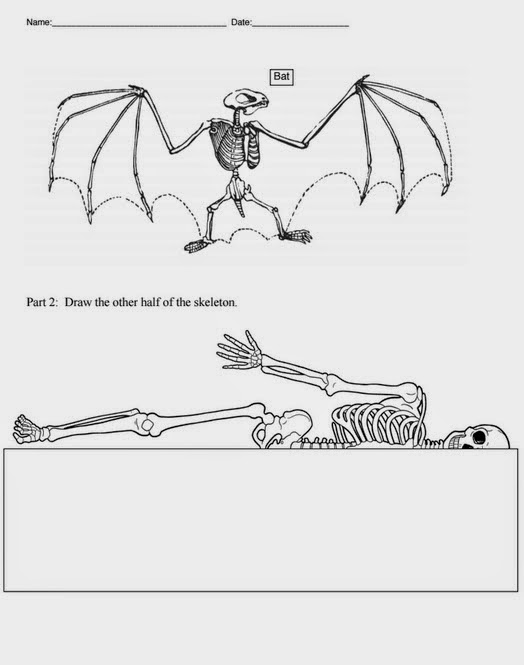
We then went into independent work time. The worksheet was quite simple, but drove home the two objectives I had: (1) learn more about the skeletal anatomy, including new vocabulary words, and (2) understand that comparative anatomy suggests we all descended from a common ancestor.

Oh yeah, and throughout the lesson I talked about how this suggests we all had a common ancestor.  A long, long, long, long time ago, there was the great-great-great-great-great-great-great-great-great-great-great-great- etc. etc. - great grandfather, and from him, we got all of the animals on earth.

Again, tie in the bell ringer.  The skeleton of the two species are going to be the same.  Why would your body put in energy to completely change it when it worked great in the first place?  It might look a little different; for example, a longer neck will mean more vertebrae; but in the end, it's essentially the same skeleton.

Bring in the worksheet: (to download, scroll down to the bottom of the page)


As they did this, I had one group at a time come to our bone cleaning station.  They were to take their bag of bones from the owl pellet lab and clean them all from any left-over dirt and hair.  I'll bleach them   for a little while before our next class, and then we'll start gluing them onto poster paper to make a skeleton image of the diseased pray.

Thus, the worksheet was perfect for our purposes. It solidified our objectives and was simple enough for the kids to complete by themselves with minimal questions asked.  This allowed me to help monitor the bone cleaning station more closely.  Plus, we had music playing in the background, which always makes life more enjoyable.  Successful teaching day.

Monday, April 6, 2015

Owl Pellet Dissection

This was an awesome class.

Have you ever dissected an owl pellet before??

Do you even know what an owl pellet is?  Well, let me inform you.  An owl will swallow it's meal whole, usually.  However, it does not digest everything it eats and the only way for it to get out safely is for the owl to regurgitate it.  Thus, a ball of hair, bones, and saliva are excreted from the owl's mouth.  The pellet.
Owl Pellets for use.  They seem small, but you'd be surprised how many bones you find inside one pellet.

Sounds disgusting, right? Yeah, well, it is if you think to much about it.  I had one of my students put on a permanently disgusted face the whole time I was explaining our task for the day.  But once you get into it you kind of forget what you're working with and just focus on discovering all of the bones in your pellet.

Can I just say that I have never had an entire group of middle schoolers so quiet and captivated for an entire 40-minute period?  They loved it.

Our beginning Bell Ringer.  The writing on the poster was small, so I allowed the kids to come up to the board to get their answers.  The red answers are what they told me after everyone was done.  
One of the posters in our board.  This was a great visual to use.
This dissection was optimally placed in our curriculum.  The kids had just taken a 3-day test and were exhausted.  No one wanted to do any work (teachers included).  So I scheduled our dissection for Thursday––after the test and right before spring break (another reason no one wanted to do any work). In and of itself it is engaging, and there is so much you can learn in a single session.  Plus, the kids are basically discovering and teaching themselves, so all the teacher has to do is facilitate that flow of knowledge.
This was the poster-sized bone chart.  Each partnership also had their own bone chart to use.
All of the posters in the class that day.  Available for students to use and compare their own bones to.  

What you learn in an owl pellet dissection:

  • Lab safety
  • Food Webs––what is the owl eating?
  • Physiology––digestion of owls and bone structure of small rodents.  Also, how many animals can an owl eat at one time?
  • Scientific Inquiry––what animal does this skull belong to and why do I think that?
  • Environmental Factors
  • Ecosystems
  • Evolution –– common descent with bone structures
  • Anything you want 
This can be done in one class period, or you can extend it into an entire interactive project.  I'm going to try and extend this project out. Not only are we done with testing (thus, relaxing the schedule a bit), but this is an engaging project and many students have already asked the next steps, i.e. what are we doing with the bones we've found?

So I'm excited.  The kids are excited.  This is an excellent project for any age.  The pellets are a bit expensive, but believe me when I say they are totally worth it.  TOTALLY.  So worth it that every year our principal buys enough for the entire 7th-grade to do this dissection. 

This video came with the materials, I think.
It was a great 15-minute introduction to Barn Owl life and the Owl Pellet Lab.
Starting the dissection

They split their pellet in two so they could each work on a section.


Very cool discovery––a skull!  A hairy skull, but a skull nonetheless.


One group's pile of bones. 

Saturday, April 4, 2015

The Scientific Method & Bias

The last day of Review week I decided to take all class reviewing the scientific method.  We had just finished our ecology unit, so I didn't want to take time reviewing that again.  There are probably going to be questions on the test dealing with making a hypothesis or conclusion, or evaluating bias, so we needed to spend time on that.

Because the term bias was newer to kids, this was a little slower than the last two days of review.  Basically, this day wasn't review at all, but just test-prep.

Also, notice that each day there is an additional Brain on our worksheet.  Our brains are getting stronger.  Isn't that cute????? :)


Friday, April 3, 2015

Reviewing Heredity

Review Day Two: Heredity.

This covered 2 months worth of material.

sexual/asexual reproduction
inherited vs. acquired traits
dominant and recessive traits
karyotypes
a little bit of natural selection mixed in there, too.

The kids did well on this, though not as well as cells. But there was still many good answers and good energy in the classroom.

Click here for the review worksheet.


Thursday, April 2, 2015

Reviewing Cells

Two weeks ago my 7th graders and I engaged in a week-long intense review of everything we had studied this year.  The reason:  7th grade Standards Based Assessment in science was the following Monday.

Day one: Cells

Everything about cells

Plant/Animal Cell Structure and Function
Unicellular/Multicellular
6 Characteristics of Living Things
Biotic/Abiotic
Mitosis
Photosynthesis
Cellular Respiration

That's about 3 months worth of material that we went over in one day, and I was wondering how my kids would do.

Answer: AWESOME!  My kids did SO well on this review and it really made me so proud as a teacher.  The only thing they had trouble with was unicellular/multicellular, but we never spent much time on that and they're big words and if you have a learning disability and can't read very well in the first place then big words like that will scare you off.  Yeah.

We spent half of the class going over everything and then I gave them the other half to complete the review worksheet, which can be downloaded at the bottom of this page.


Monday, March 30, 2015

Orienteering

New Mexico Grade 8 Science Standard I (Physical Science):  5-8 Benchmark III.
 #6:  Know that the Earth has a magnetic field.

This could be a 2-minute lecture on the earth having a magnetic field.  But when it's the last day before spring break, why not make it an entire 90-minute class period?

Welcome to Orienteering 101!


I handed out the little compasses to each student and we practiced learning how to use them.  Always remember that North is with North.  Then find your direction.  

I then took the class outside to the baseball field. I had closed it off to everyone else with big signs, and during my prep period (there have been many times I’m grateful that prep is first for me) I set up the orienteering course.  It took me about an hour to get everything set right, and then the rest of the period to perfect it and get everything ready
 

My first class did awesome.  They were in groups of two and each had a different course to take.  There were 8 markers around the field.  They got their first clue from me in the center, and then went off in the direction of their clue.  There they would find a new clue for their group that would send them in a different direction to another marker.  The first group back to me with all of their markers in the correct order won and got a prize.  It was fun, because the first group back actually didn’t have their markers in the correct order, so I sent them back at their second marker where they had first messed up.  They ran back.  I had a couple other groups come back with answers really close, but had 1 or 2 wrong.  In the end, we had a winner.  There were only 15 minutes of class left when everyone had finished (of a 90 minute class), and it being the last day of the week I told them they could do whatever.  Some joined the PE class on the next field in playing soccer.  Other sat in the shade of the dug-out.  I went around and made sure all of my clues were at the right markers and then sat in the dug-out with my class.  


My second class came in and didn’t do as well.  They could not figure out that North had to go with North.  They were trying to get the needle in the compass to move instead of physically changing the direction of the compass to match the needle.  I still had a winning group, but it was harder with this group.  I think it’s a combination that I missed a step in my introduction and that this groups had a higher percentage of lower abilities than my last class.  Also, it was much hotter this time.  But we only had to do this for half the class because this class had finally earned their class party.  After the winner came in, I gathered them all up and we went back inside.  They were good enough to help me pick up the markers and take down the signs before we left, though.  Then they sat in my classroom for the party where they ate chips that they brought and listened to music.  It was pretty chill.  But it worked.  :)


An example marker.  The Marker paper should be under the rock.  This is what happens after kids have been by.